During her presentation at the WMEFS symposium, Summit Steward Whitney Lee proposed restructuring summit-steward responsibilities in a way that could, over time, restore the trails of the Franconia Ridge Loop within the alpine zone. At the heart of her proposal is training summit stewards in more advanced stone masonry so that they can spend several days each week tackling significant restoration projects at high-priority off-trail hotspots. This would replace some of the time now devoted to repeatedly rebuilding scree walls, which have become increasingly ineffective as visitor use on the Ridge has grown.
To define trail boundaries more clearly, Whitney proposed expanding the use of string fencing, which has proven highly effective. Its appearance and durability could be improved by shortening the poles and anchoring them in rocks as was done at the Welch Ledges this season.
Her trail-work recommendations include:
➔ Limit scree wall upkeep
➔ Use more string fencing
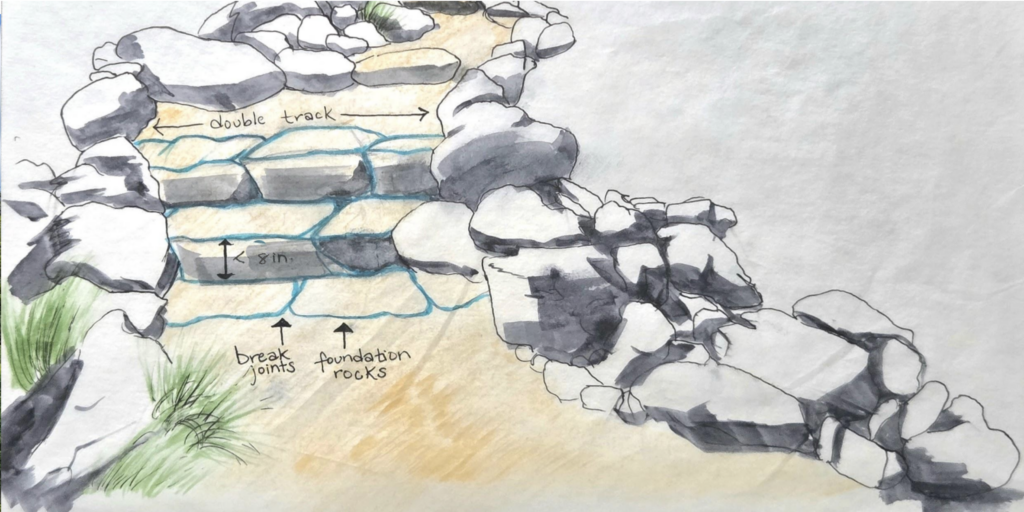
➔ Where possible, develop sections of double-lane tread between up to 60 inches wide (USFS Trail Class 3 for hiker/pedestrian)
➔ Maintain and add “pullouts” where visitors can pause, rest and let others pass
➔ Reconstruct steps that are less than 8 inches high
➔ Overlap steps
➔ Crush loose rock into tread and behind steps
➔ Place foundation rocks below steps
An important constraint shapes this proposal. Recreation ecologist Jeff Marion has recommended moving portions of the Franconia Ridge Trail off the ridge itself and constructing a sidehill trail as a way to reduce off-trail behavior, protect alpine vegetation, and reduce erosion. The U.S. Forest Service has taken substantial realignment off the table. That leaves us with the task of improving the tread within the existing steep, fall-line ridge alignment. If the trail cannot be realigned, it must be redesigned to function better where it is.
Whitney used the South Lincoln Scrambles as a “microcosm and experimental blueprint” for this approach. Logan Tillinghast’s audit found that this section has an average grade of 34.4 percent, numerous high steps and unclear trail boundaries. It also had the highest observed rate of off-trail behavior: 24.46 percent. Whitney’s drawing translates those findings into a possible redesign. Rather than trying to funnel hikers through a narrow, deteriorating staircase, the proposed tread would provide lower, overlapping steps; foundation stones and break joints for structural stability; crushed rock packed into the tread; and double-lane tread where conditions warrant. A pullout could give hikers a place to pause or allow others to pass without stepping into vegetation.
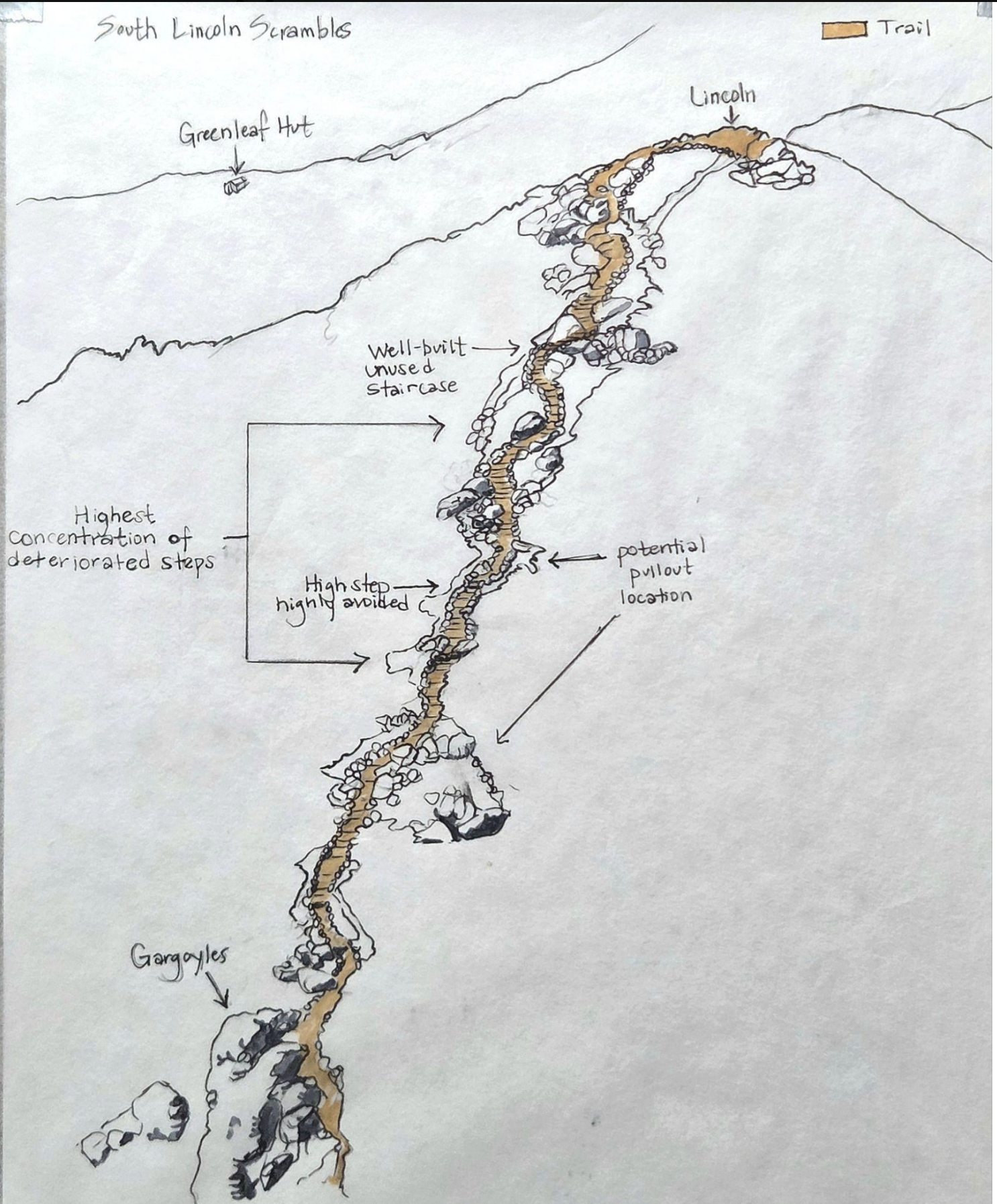
The South Lincoln project could be completed in stages and monitored as an experiment. Students could document existing conditions and visitor behavior; trained summit stewards could construct specific improvements; and future field schools could evaluate whether the redesigned tread reduces off-trail travel. The results could then guide work at other hotspots along the Ridge.
These recommendations amount to more than a collection of trail-building techniques. They represent a shift from relying primarily on large, episodic reconstruction projects toward continuous, adaptive stewardship. The field school can identify and study problems; summit stewards can provide the sustained presence needed to educate visitors, complete skilled repairs and monitor the results; and experienced trail tenders can contribute practical knowledge accumulated over decades. Research would guide restoration, restoration would generate new observations, and the work could be adjusted as trail conditions and visitor behavior change. The emerging Alpine Stewardship Center would provide an institutional home for this approach—connecting research, education, trail construction, routine maintenance and long-term monitoring in a single program capable of caring for Franconia Ridge over time.