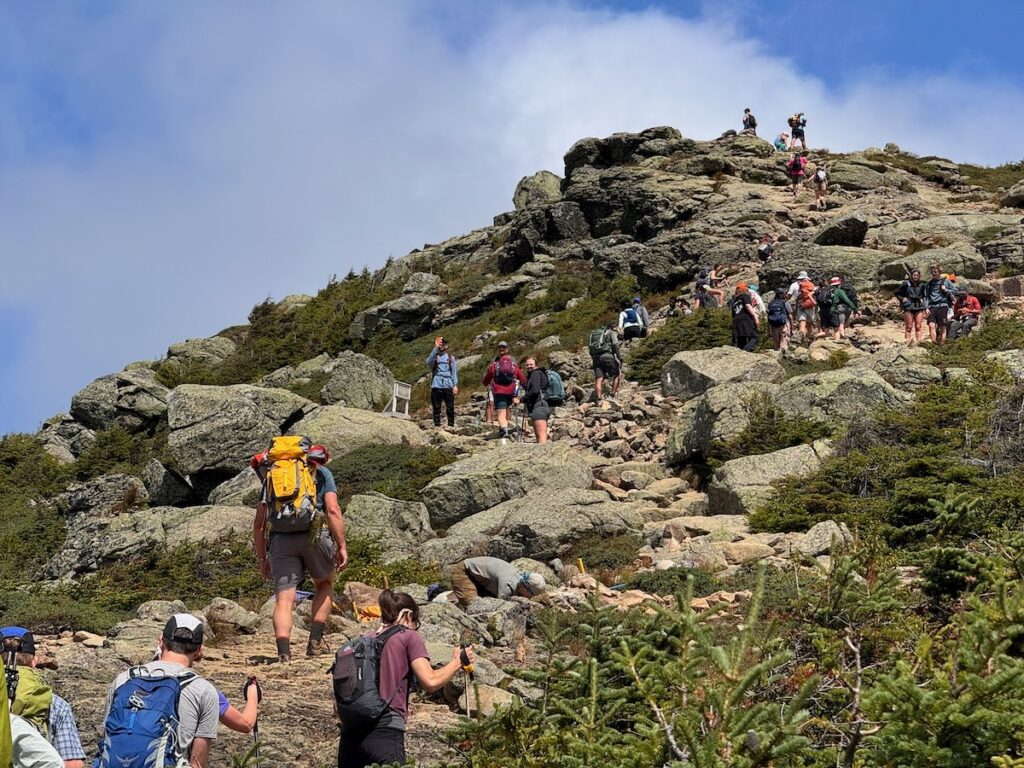
Some of you may remember an open letter I wrote two years ago titled “It’s Time to Act.” I argued then that Franconia Ridge had exceeded its capacity to accommodate current levels of visitation without continued damage to alpine plants and soils, and that we urgently needed to complete the Visitor Use Management (VUM) plan based on the Interagency Visitor Use Management Framework planning process begun by the Franconia Ridge Working Group (FRWG) in 2016. I pointed to a Saturday in 2024 when we recorded 1,137 visitors on the ridge.
Saturday, August 15, 2026 the count was 1,441.
That is more than 300 additional people in a single day, or a 27% increase.
Meanwhile, year after year, our Summit Stewards and students continue to document the relationship between crowding, off-trail movement and damage to the fragile alpine environment.
The FRWG has not met in three years and the VUM plan remains unfinished. A major initiative to “restore” the Franconia Ridge Loop on federal land is concluding this fall after five years and 1.125 million dollar investment—without contributing any work to the sensitive alpine trail between Little Haystack and Lafayette. Indeed, as various people have commented, the work on the approach to Franconia Ridge on the Old Bridle Path and Falling Waters Trail has arguably had made the trail more accessible and put more stress on alpine plants and soils. Similarly, the decision to enforce a parking ban on Interstate 93, shift parking to the Cannon Mountain ski area parking and offer shuttle service to the Old Bridle Path, eliminated the safety problem of people parking and walking alone the highway, but de facto increased the parking capacity for the Franconia Loop trailhead, also adding more pressure to the alpine zone. We solve one problem and create another. This is what happens when solutions are pursued piecemeal rather than as part of an integrated plan.
I think we can change the wording of my original open letter and say:
It is past time to act.
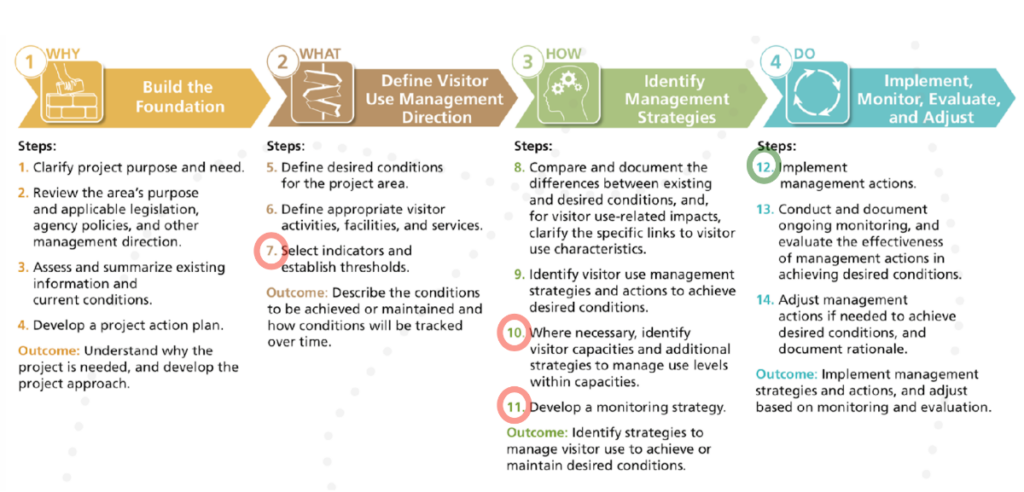
Every season that passes without formally establishing indicators, thresholds and visitor capacity—what is called for in a VUM plan—leaves us without the management framework we need to guide trail design, education, stewardship and long-term investment in trails and alpine zone protection. And while planning is stalled, damage to alpine vegetation and soils can happen in minutes when hundreds of people go off trail in a day. It only takes few hundred people a year going off trail to permanently damage vegetation and soils, what we are seeing in a day. What is lost may represent decades, or even centuries, of growth and soil development.
The absence of a completed VUM plan does not mean that nothing can be done. Despite our collective failure to finish that process, we are acting where we can, with the resources we have.
The Alpine Stewardship Center, WTN Americas/Pan American Trails with support and collaboration from the U.S. Forest Service and Appalachian Mountain Club and other partners, is testing practical ways to better manage the Franconia Ridge Trail between Little Haystack and Lafayette. one of the most heavily visited alpine trail sections in the Northeast.
This week’s work on the Lincoln Scrambles South was a test of our proposal. It is deliberately modest in scale, grounded in observation and research, and designed so that we can learn from what happens next.
In other words, while we continue to advocate for the larger management framework Franconia Ridge desperately needs, we are not waiting to begin the work