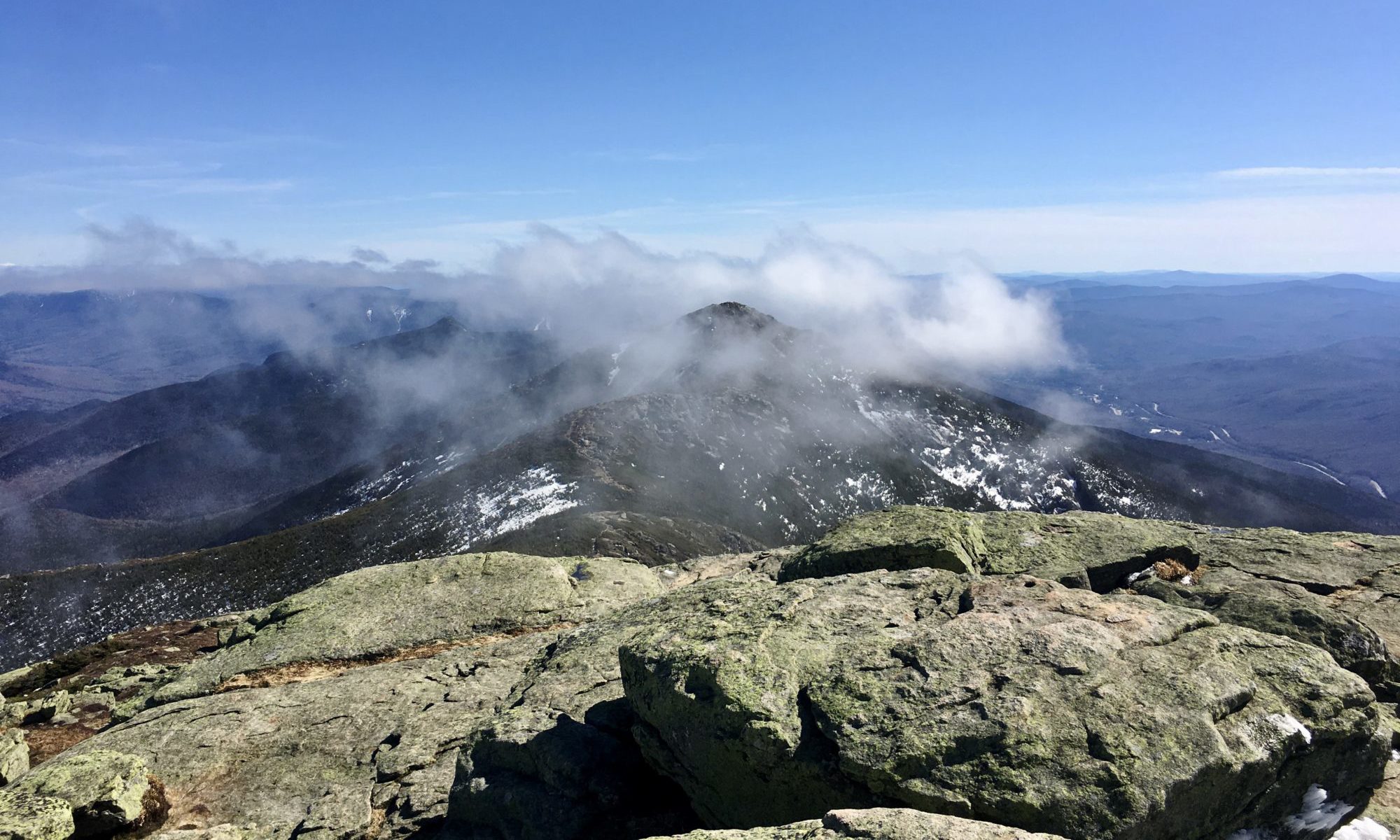
This is the third in a four-part series reflecting on the accomplishments of the Franconia Ridge Loop Restoration, what we could have done better, and where we go from here.
In the previous article, I discussed some of the things we got right in the Franconia Ridge Loop Restoration: trail realignment, reverse-grade drainage, carefully designed step clusters, foundation steps, full-bench construction, proper tread preparation, and trail widths appropriate for very high levels of use.
Together, these represented an important advance toward a new standard for sustainable trail construction in the White Mountains.
But we did not apply that standard consistently. Understanding why is important, not to diminish what has been accomplished, but because the lessons from this project should inform how we plan the next generation of major trail projects.
An Ambitious Goal Without a Complete Plan
We should begin by acknowledging that the original goal of the project, to “redesign the Franconia Ridge Loop from start to finish,” proved overly ambitious given the available funding and the actual condition and use level of the trail.
As mentioned in the first article, five years later, substantial work remains even on the two major approach trails, Old Bridle Path and Falling Waters Trail. Only a relatively small amount of work has been completed on the upper Greenleaf Trail in the alpine zone. And no congressionally funded restoration work was undertaken on perhaps the most ecologically sensitive portion of the entire Loop: the Franconia Ridge Trail between Mount Lafayette and Little Haystack.
Part of the problem was built into the project from the beginning.
The approximately $1.125 million in Congressionally Directed Funding was not the result of a detailed assessment of every section of the Loop followed by engineering and trail-design estimates of what it would cost to rebuild it. Rather, it represented the level of funding that could be secured through the congressional appropriations process.
That is understandable. Nothing comparable had previously been attempted on this scale in the White Mountains, and more than a million dollars sounded like an enormous investment in a single trail system.
And it was an enormous investment.
It just wasn’t enough to accomplish the stated goal.
The Missing Variable: Use
One reason the cost was underestimated was that we had not fully incorporated the extraordinary volume of use on the Franconia Ridge Loop into our understanding of what reconstruction would require.
Today the Loop receives approximately 45,000–50,000 visitors between May and October. That changes almost everything about trail design.
A technique that might perform adequately on a trail receiving a few thousand hikers annually can deteriorate rapidly when thousands of boots pass over it in a matter of weeks. A narrow tread that works perfectly well elsewhere can result in hikers continually stepping around one another. Organic soil that might gradually compact and harden on a lightly traveled trail can quickly turn into mud, exposed roots and displaced tread material. A drainage feature requiring regular cleaning becomes a significant liability if the maintenance system cannot reliably provide that cleaning.
Add increasingly intense rain events, and the engineering challenge becomes greater still.
This had a cascading effect on the project. As it became apparent that the available money would not rebuild the entire Loop to the standards we had envisioned, choices had to be made about how far the money could stretch.
There was another structural problem as well. The congressional funding applied to the portions of the Loop on federal land, leaving significant sections of the Old Bridle Path and Falling Waters Trail within Franconia Notch State Parkoutside the federally funded project.
WTN Americas was ultimately able to secure private funding, later supplemented by a New Hampshire Recreational Trails Program grant, to begin filling that gap. But ideally the Loop would have been conceived, assessed, designed and funded from the beginning as one trail system crossing two jurisdictions.
We Established Standards, Then Lost the Mechanism for Maintaining Them
There was an important effort at the beginning of the project to address precisely these questions.
The Partnership to Restore the Franconia Ridge Loop formed a trail standards working group during the first year. That group brought people together to establish many of the design and construction principles discussed in the previous article.
That was exactly the right idea.
Unfortunately, the working group stopped meeting.
Without a continuing mechanism for reviewing design, comparing work among different crews, documenting what was being learned, and adjusting standards as the project progressed, some of those standards were applied inconsistently.
Four examples stand out.
Trail Width
One was tread width.
Early in the project, we recognized that a trail carrying tens of thousands of hikers must be wide enough to accommodate actual visitor behavior, including people passing one another without continually stepping off the constructed surface.
As costs increased, however, reducing tread width offered an obvious way to make limited funding cover more trail.
In some places, I believe this went too far.
There are reconstructed sections where the tread is narrow enough that hikers meeting one another are likely to step outside it. At Franconia Ridge levels of use, thousands of seemingly insignificant passing movements can eventually widen the trail anyway, except that the widening occurs through trampling and erosion rather than intentional construction.
This illustrates one of the central lessons of the project:
Reducing the dimensions of a trail does not necessarily reduce its ecological footprint.
Sometimes spending more to construct a wider, durable tread is precisely what allows us to keep people within a smaller overall corridor.
Foundation Steps
Foundation steps were another standard applied inconsistently.
As discussed in the previous article, a properly placed foundation stone at the base of a stair cluster protects the staircase from being undermined as water and foot traffic remove soil below it.
For some crews, this represented a different approach from their previous stonework practices. It also requires another substantial piece of stone and additional labor. Under the pressure of time and budgets, that additional work can seem expendable.
It isn’t.
Where a staircase is undermined from below, the effective height of the bottom step increases and the stability of the staircase above can eventually be compromised.
We are also discovering something we did not fully anticipate. In some locations, foundation stones that were originally flush with the tread, or even slightly buried, are now protruding two to four inches after only a few years as surrounding tread material erodes.
If that continues, a foundation stone intended to protect a staircase can eventually become a step itself, but a step with no foundation stone beneath it.
That tells us something important. Even some of our improved construction techniques need to be monitored over time and modified in response to what actually happens on a trail receiving this intensity of use.
Waterbars Versus Drainage Built Into the Trail
We also did not consistently make the transition from traditional waterbars to drainage created through trail alignment and grade reversals.
Some newly reconstructed sections still rely on waterbars. Several are already beginning to collect sediment and debris.
The problem is not that waterbars never work. They do. The problem is that their effectiveness depends upon maintenance.
And this exposes a larger contradiction in White Mountain trail management: we continue to build drainage structures that depend upon a level of routine maintenance we often do not have the capacity to provide.
Where terrain allows, reverse grades and appropriately shaped tread offer a fundamentally different approach. Instead of asking someone to repeatedly restore the drainage, we build drainage into the geometry of the trail itself.
That distinction becomes increasingly important as rainfall becomes more intense and maintenance needs increase.
What Lies Beneath the Tread
Perhaps the issue that concerns me most as the federally funded phase of the project concludes is tread preparation.
In some sections we underestimated the depth of the organic soil beneath the existing trail.
On a lightly used trail, it may sometimes be possible to allow a new tread to evolve gradually. Organic material compacts or erodes, rocks and roots emerge, and crews return periodically to improve the surface as the trail hardens.
Franconia Ridge doesn’t provide that luxury.
Thousands of hikers can pass over a newly reconstructed section in a matter of weeks. If unsuitable organic material remains beneath the tread, deterioration that might take years elsewhere can happen in months.
During these final weeks of the project, there is understandable pressure to finish as much trail as possible. In some places, that has meant leaving more organic material in the tread than I believe is desirable.
What happens next will be instructive.
With careful monitoring and rapid intervention as problems emerge, it may be possible to progressively harden these sections. But that requires professional trail crews to return when problems first appear, rather than years later after deterioration has become severe.
In that sense, we are conducting an unplanned experiment in adaptive trail management.
The experiment may work.
But only if somebody is there to observe the results and has the resources to respond.
And What About All Those Steps?
There is an even larger design question worth asking.
As I described in the previous article, one of our White Mountain compromises has been to alternate lower-grade side-hill trail with relatively short clusters of stone steps. This allows us to gain elevation within constrained terrain while avoiding a continuously steep trail.
I continue to believe this can be an effective approach.
But a trail designer looking at the Franconia Ridge project from outside the White Mountains might reasonably ask:
Are we still building too many steps?
Stone staircases are enormously expensive to construct. Hikers sometimes bypass them. They concentrate elevation gain into short distances. And unless drainage is carefully incorporated into their design, water can accelerate down them and erode the tread below.
The question should not be whether steps are good or bad. It should be whether we have found the right balance between steps, climbing turns, longer contour alignments, grade reversals and other ways of gaining elevation.
Franconia Ridge gives us an extraordinary laboratory in which to answer that question.
The Larger Lesson
None of these shortcomings negate the accomplishments of the Partnership to Restore the Franconia Ridge Loop.
Quite the opposite. We now know much more than we did five years ago.
But perhaps the most important lesson is that the next project of this scale should begin differently.
Before announcing that we will rebuild a trail from start to finish, we should conduct a detailed trail log and condition assessment. We should document visitor volumes and behavior. We should divide the trail into management and construction units, identify the appropriate design treatment for each, establish construction standards, estimate costs from those designs, and then determine the funding and timeframe required.
And the standards group should not disappear once construction begins.
It should become a standing design and technical review team that walks completed work, compares approaches among crews, monitors failures and successes, and updates standards throughout the life of the project.
Most importantly, we should stop thinking of a major trail restoration as something that is finished when the construction grant ends.
A trail carrying 45,000–50,000 visitors through steep mountain terrain in an era of increasingly intense rainfall requires continuing professional attention: monitoring, maintenance, reconstruction and adaptation.
That brings us beyond the Franconia Ridge Loop Restoration itself.
The problems described here are partly problems of planning, design and construction. But they also expose something larger: a trail management system in the White Mountains that has not kept pace with the intensity of recreational use, the increasing demands on our trails, or the changing climate in which we are asking them to survive.
Franconia Ridge has given us an opportunity to develop a new standard for building trails.
The next challenge is developing a management system capable of sustaining them.