Wendy Skinner
The word “walk” originated from the Old English “walken” which stems from a Germanic term for rolling something about. At the beginning of the 13th century, it began to be used to describe the rolling gait of traveling on foot. The word “hike” is much younger. It dates from a mid-18th century East Anglian dialect, and originally was a pejorative term for “begone, go away.” It had another meaning, of pulling or jerking something up, as in hiking prices or hiking up your pants. Only about a hundred years ago did the word “hike” come into common parlance as a long, vigorous perambulation.
Where I grew up in rural Indiana, walking was both a necessity and a pleasure. My mother and I often walked an hour on a dirt road to hail the bus that took us into town. On weekends when my father was home, he would drive through farm country scouting for what he called “a pretty place” for us to walk.
As a young man, my father had twice travelled on foot from middle Indiana to southern Michigan to work in the apple orchards. Where there was no road, he had followed paths worn through fields and forests by itinerant workers of the 1930s. I think this developed in him an eye for trail-making, and he would stride ahead of my mother and me as he deftly bushwhacked through a pretty place on someone’s remote property. With little concern for trespass, we ventured into the midwestern woods and hillsides in all weathers. We didn’t call this hiking. We called it walking.
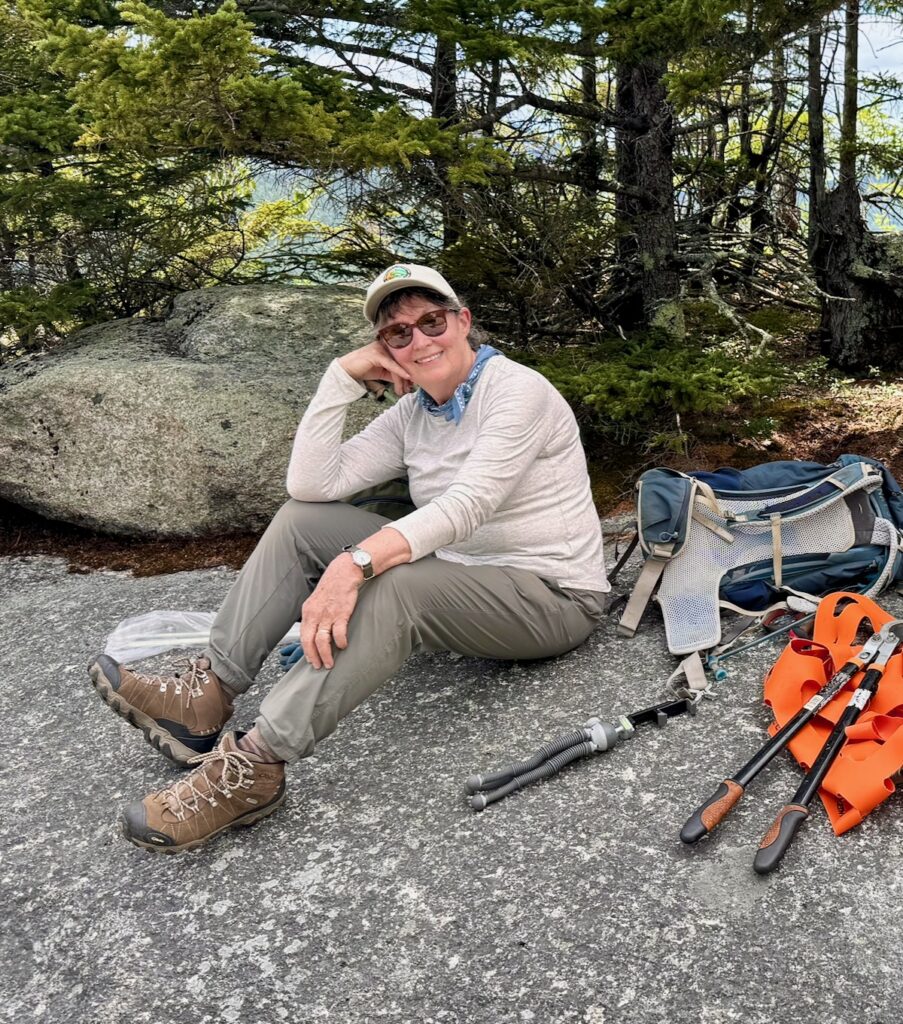
On a hot day in July, I have my first go at the well-used trail that leads up New Hampshire’s Welch Mountain. I navigate over and around boulders, teeter uncomfortably on exposed tree roots as bare as a dead animal’s stripped skeleton, and climb the ruins of stone staircases long since settled into history. I have boots and hiking poles; my day pack holds a snack and water laced with electrolytes. But I am not a hiker. I’m an octogenarian scribe, out of my element as I struggle in the wake of a legendary trail tender and a young man who skips over the rocky trail as if he were enjoying parkour. Sweating and panting, I follow behind, carefully planting each step and standing aside as hiker after hiker slips around me.
For about half the way, we are within sight and sound of a rocky creek, the clear water coursing over a bed of gravel and stones. The creek sings to the old trail which stolidly tolerates the thousands of footfalls that compact its already hard earth. I apologize to it, and to the trees whose naked roots suffer my weight, to the dislodged mats of moss and the kicked-over mushrooms.
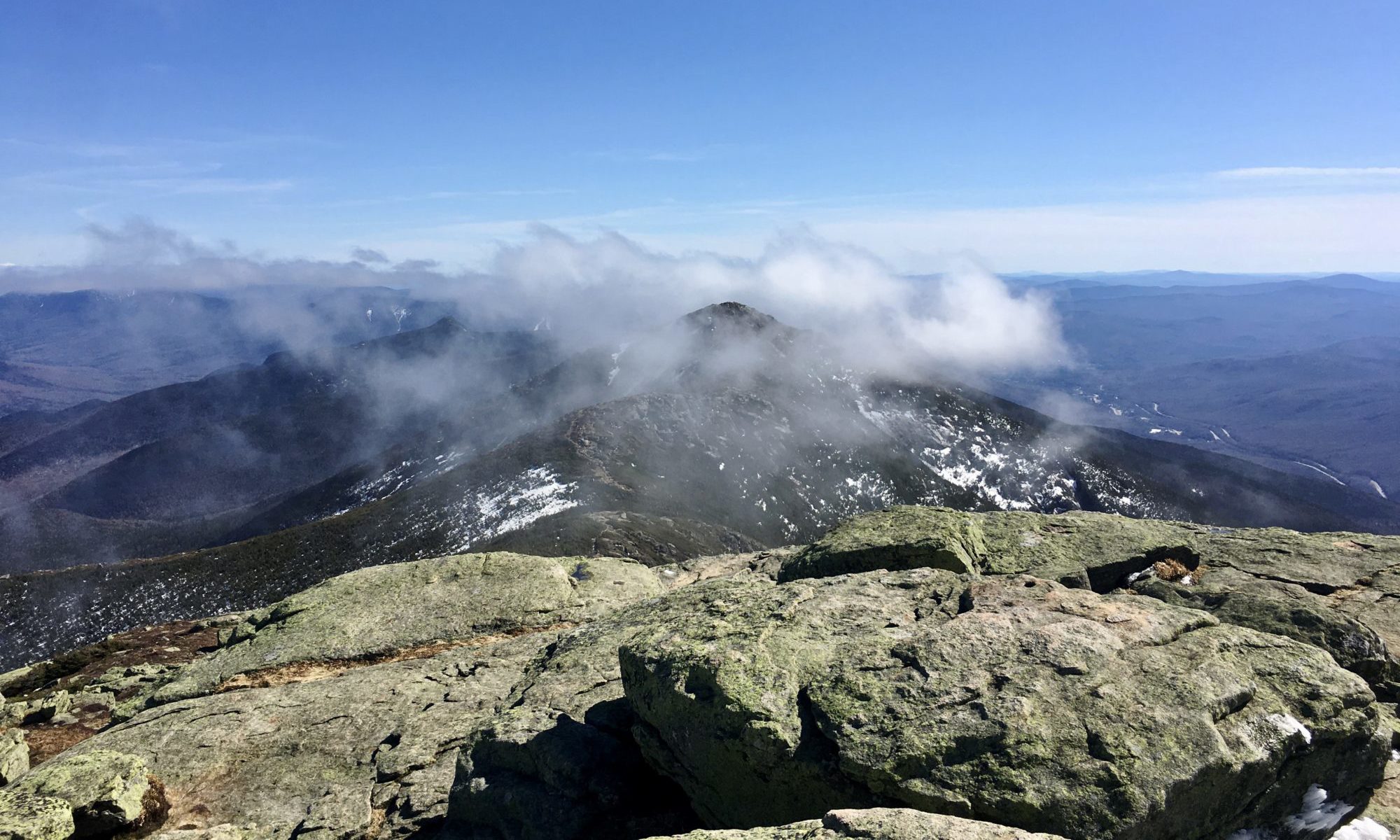
Midday has slumped into afternoon by the time we reach our destination, the Welch Ledges, a bright expanse of scoured granite with scattered patches of sub-alpine lifeforms the colors of ball gowns. I marvel at the fine-grained mosses in velvety layers of chartreuse and ocher clinging to the bases of rocks while above, tiny forests of bright green are capped by airy clusters of lichen, some silvery-gray, some a shade of bleached teal as seen on the sea floor. Clusters of five-petalled blooms balance on stems as slender as button thread.
These are the “islands” of the Ledges, individual, exquisite, and dwindling communities of organisms that can survive the harshest weather nature can whip up, but whose greatest enemy is the human foot. One misplaced footstep can wipe out a lifeform that has grown here for decades or more. I’m here as a novice trail steward, assigned to learn about and protect these fragile islands from further tramplings.
I have cut the time of my uphill climb in half. This late afternoon, I get into a rhythm, each step on the downbeat. I swing along, thinking this must be what it’s like to be a true hiker. It’s dusk when I arrive at the Ledges. I walk around the islands to the 180-degree view of the Sandwich Mountains and beyond. A solitary hiker is sitting on the ancient granite gazing at the peaks and valley. She glances at me with a smile of greeting. I sit down a few yards away, and we watch in silent camaraderie as the slanting light defines the slopes across the valley in changing shades of blue, and I wonder if this is what it means to be a true hiker.
My stewardship studies do not require me to clamber up the mountain as often as I do, but I don’t know how else to understand it. When an evening rainstorm is expected, I pack a rain jacket, water, food; get to the trailhead around 3 pm and cross paths with the last person I see on the mountain today.
Part of my work is to create mulch to encourage growth in the bare spots of the islands. We can’t drag it up from below. It has to originate from this environment. I scrape dirt from a muddy section of the trail, crush rotting logs into wood chips, and scatter this concoction onto the islands closest to the look-out. It’s 60 paces from the muddy trail to the biggest bare patch, and 60 paces back. 60 paces from; 60 paces back. For two uneventful hours, I follow this routine, all while keeping a watch on the sky.
White walls of rain are pouring down on the near peaks. As the storm moves steadily toward me, I begin feel its power. Eddies of moist air swirl ahead of the bank of dark clouds whose speed I have underestimated. There is no thunder or lightning yet, but even as tell myself I’m safe, I don’t believe it. Abruptly, a sideways blast of wind stirs up grit and twigs that peck at my head and bare arms. Less than a minute later, the rain hits. I skid and slide down to a cove under the trees as the rain pounds the bare granite and ricochets off the hard surface. Sheets of water are blown across the rock in concussive waves.
Bright flashes send bursts of thunder echoing overhead. I creep deeper into the forest where the canopy deflects some of the downpour, and I come upon mounds of lichens, knee-high, billowy, and spongey with life. The smells here are rich and spicy, the colors exotic, almost glowing. The communities I’ve been tending on the ledge are sad remnants of what I’m seeing here. I stand in this gallery of otherworldliness barely breathing, nearly as still as the implacable granite core of this mountain.
When the rain subsides, I emerge to find the bare slopes clean, the islands swollen with wet. Water rollicks its way down the mountainside. Rivulets muddy the darkening trail.
A morning comes when I realize that I don’t want to be a hiker. I want to be what I have always been: a walker. With respect to those who feel otherwise, I believe that to hike is to get there, to walk is to be there. I want to walk “to shake off the village,” as Thoreau wrote.
Hiking is purposeful.
Walking is contemplative.
I cannot exclude from the noble art hikers who may let their thoughts be guided by their environment, who write poetry and odes, and refrain from taking endless selfies to prove they’ve been somewhere—but I hesitate to welcome peak baggers and trophy seekers. That’s sport, competition, acquisition, and more generously: accomplishment and self-building. The walking I practice doesn’t seek to win prizes or check something off a list. Walking is introspective, a thing unto itself, a mood. It offers a sense of place and of being. Some would attribute these elements to the trail, but without a living creature walking it, the trail is neutral, waiting.
The pilgrim is a walker.
The mountaineer is a hiker.
Robert MacFarlane writes in the forward to Nan Shepherd’s The Living Mountain: “The pilgrim contents herself always with looking inwards to mystery, where the mountaineer longs to look down and outward onto total knowledge.”
I sometimes feel, when I am on a wooded path, that I am walking through my own body, that the trail is an artery or a vein or a branching nerve. I see myself in the connections of the tree roots whose sinews intertwine. I sense in the web of fungi lying just below the soil, emitting lusty odors and the hint of decay that accompanies change, as the same life threads that seal my skin to my muscles, and cradle my heart in its cage of bones.
I’ve become strong enough to continue up to Welch’s summit—the Ledges are just the first stop—and I discover that the trail beyond, which attracts fewer visitors, climbs through untrampled peninsulas of sub-alpine flora. Lichens and mosses, mountain blueberries, and tiny white flowers flourish. I spy some specimens of jack pine, a rare tree that thrives in the thin, acidic soil of Welch’s higher outcroppings. My boots are gripping bald granite, some bits of its surface still gleaming with the glassy polish left by the retreating glaciers. The trail steepens, curves. Yellow blazes point to natural rock ladders and shelves. I hoist myself up, and if I have to, I resort to spidering up the granite on all-fours. This scramble is surely as exhilarating as parkour.
The lower trail to the Welch Ledges was built with one goal in mind: to get to the top as quickly and directly as possible. From its very beginnings, it was a route for water, which has made it a victim of erosion, rugosity, and widening. This trail is failing us, and I believe that its unfortunate crudity influences its followers to be less aware of their surroundings. They just want to get through it. I wish for another way to reach the vistas—a meandering way, a berry-pickers’ way, a walker’s way.
To hike, to walk, to stroll, to saunter, to meander—maybe the exact word doesn’t matter if we allow ourselves to slow down, to quiet our thinking, and to take a long look around.