One of the questions we have been asking over the last several years: When does a busy trail become a crowded trail?
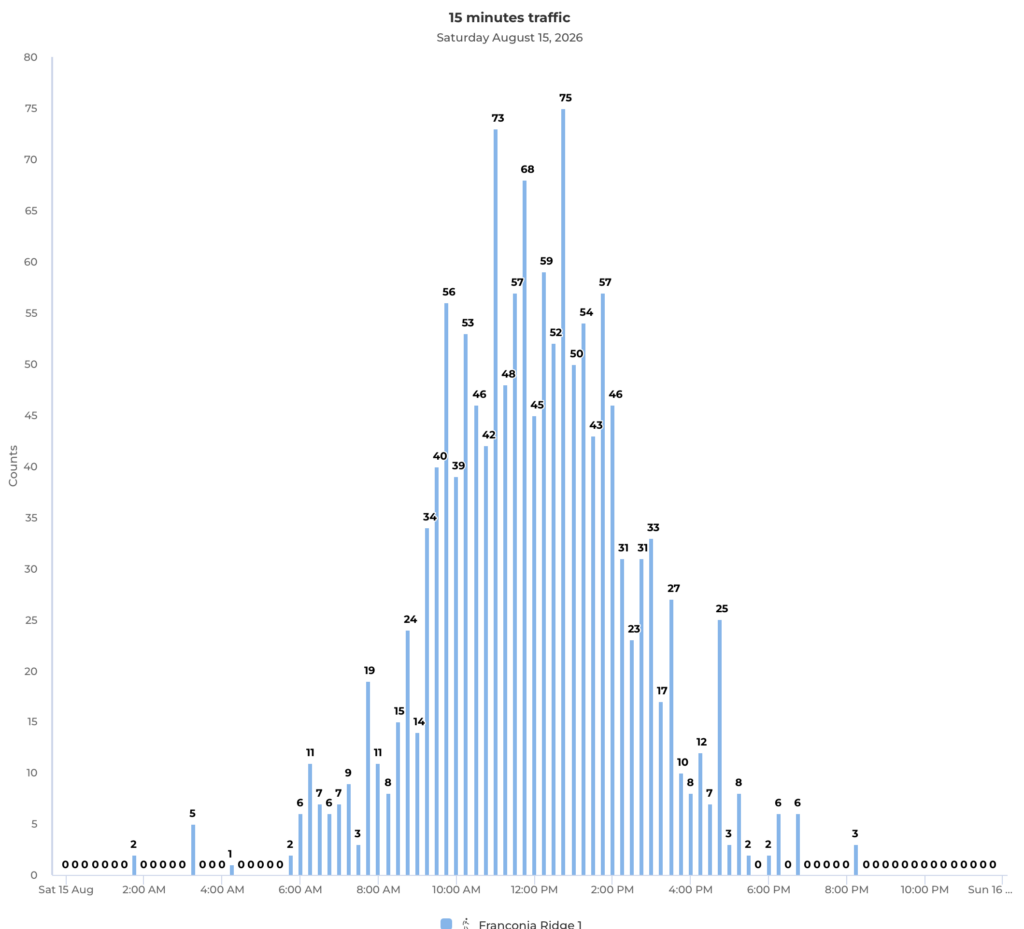
The trail counter on Franconia Ridge provides part of the answer. It records the number of visitors passing a point on the ridge and, importantly, the direction they are traveling. Looking at the data by hour reveals a remarkably consistent daily rhythm. Visitor traffic builds rapidly through the morning, generally peaks between 11:00 a.m. and 1:00 p.m., and then declines through the afternoon.
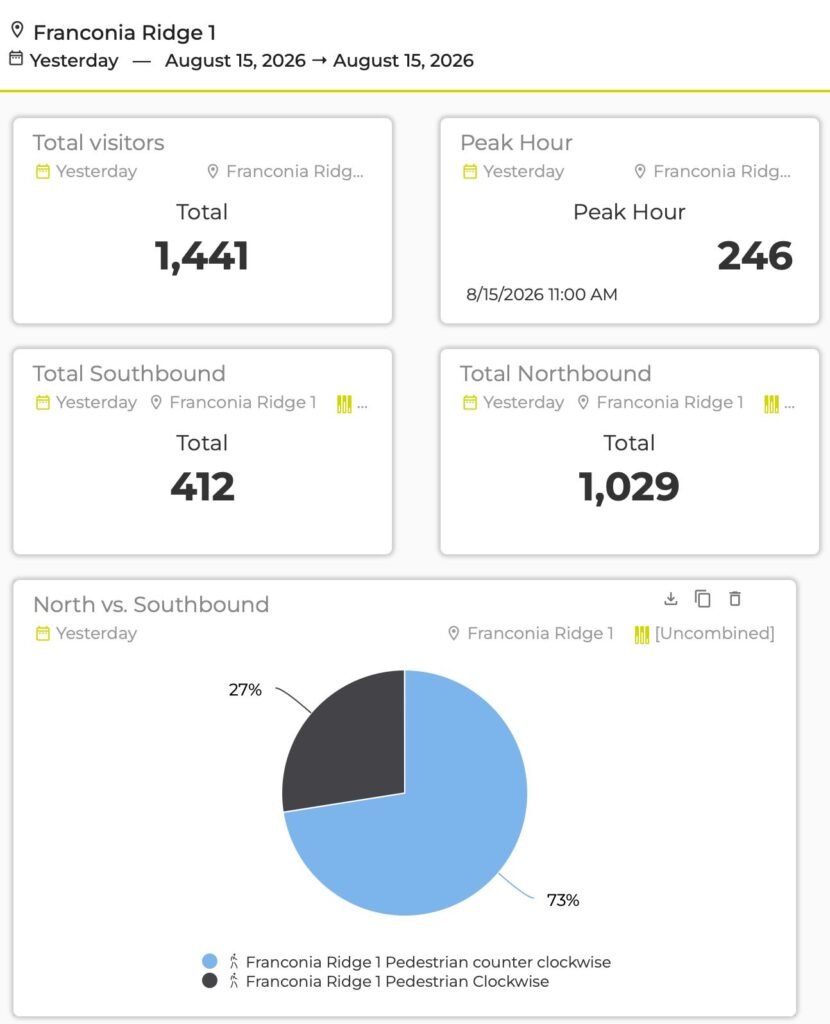
But not all days are alike. Saturdays operate in an entirely different realm from most weekdays. During the summer we recorded several Saturdays with more than 1,000 visitors. On August 15 the trail experienced a record 1,441 visitors in a single day—a record number. This last Saturday, August 22, we also exceeded 1000, with 1133. Our observations suggest that under these very high-use conditions, off-trail behavior also increases sharply.
The new counter WTN Americas/Pan American Trails placed on the ridge this summer can provide data at 15-minute intervals, allowing us to look inside those busy hours. What we find is that visitors do not necessarily move across the ridge in a steady stream. They often arrive in small waves or pulses within a larger single wave , not unlike the traffic patterns that develop on a highway during periods of congestion.
On August 15, for example, one 15-minute period contained 73 visitors and another contained 75. More importantly, the pressure was sustained. For nearly five hours, every consecutive 15-minute interval contained at least 35 visitors, and for four hours the count remained at or above 40 per interval.
Volume, Intensity, Persistence, Encounters, and Passing
This suggests that crowding has several dimensions. Daily volume tells us how many people are using the trail. Intensity tells us how concentrated that use becomes over short periods. Persistence tells us how long those conditions continue.
Intensity can occur without high volume; persistence generally cannot. A large group, or simply the happenstance of several groups arriving at the same time, can create a short burst of intense use on an otherwise quiet day. But for high-intensity conditions to persist over hours, there must be enough visitors in the system to continually replenish the flow.
Because the counter records direction of travel, we can also distinguish visitors traveling north from those traveling south. When visitors traveling in opposite directions meet, we call these encounters. Two 15-minute periods containing 60 visitors therefore may represent very different conditions. If nearly everyone is traveling in one direction, there will be relatively few opportunities for head-on encounters. If 30 are traveling north and 30 south, the potential for encounters is much greater.
There is another kind of interaction: passing. Visitors traveling in the same direction move at different speeds, so faster visitors overtake slower ones.
Both encounters and passing matter because trail conditions help determine what happens when visitors interact. On a wide, relatively smooth section of trail, two visitors may pass without difficulty. At a narrow section, high step, rugged scramble, pinch point, or location where the trail boundary is unclear, the same interaction may require someone to stop, wait, squeeze past, or step off the established tread.
It becomes more complicated when we consider different types of visitors. In 2025, International Trails Fellow Rod Goés observed differences in interactions involving hikers and runners. When hikers approach one another from opposite directions, one or both may move off the tread to get by. When a hiker sees a runner approaching from the opposite direction, however, the hiker may stop and step aside, often onto a durable surface. A runner overtaking a hiker from behind presents a different situation: the hiker may not know the runner is approaching, leaving the runner to move around the hiker, sometimes in a broad arc beyond the established tread.
This gives us a more nuanced way of thinking about the relationship between visitor use and trail impacts:
visitor flow → encounters & passing → interaction with visitor type & trail conditions → behavioral response
The Importance of a Trail Audit
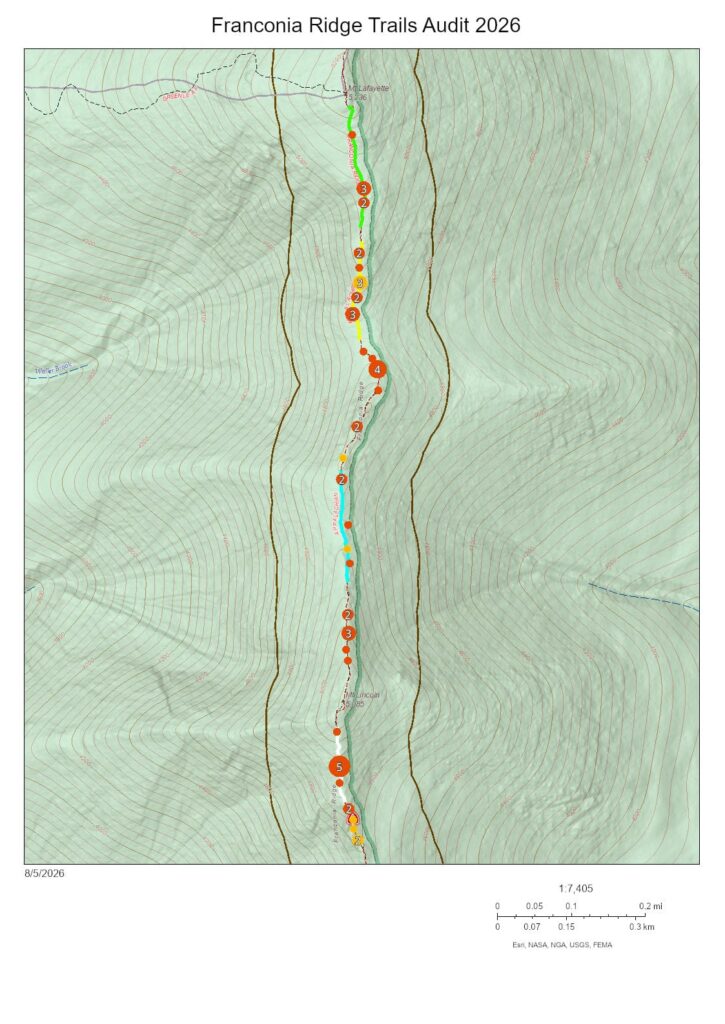
The White Mountain Environmental Field School’s trail audit adds another part of the information needed to understand this process. In 2026, students and stewards mapped many of the physical conditions associated with off-trail movement, including high steps, narrow tread, pinch points, rugged surfaces, and poorly defined trail boundaries. They also identified locations where off-trail use is already occurring.
Bringing these observations together with the counter data may allow us to test a more interesting hypothesis. Off-trail behavior may not simply increase steadily as the number of visitors increases. Instead, there may be points at which repeated encounters and passing at particular locations begin to produce surges in off-trail movement.
One visitor steps aside to let another pass. A second person follows the same line. As traffic continues, what began as an individual response can become an informal passing lane or alternate route. In this way, a combination of visitor flow, human behavior, and trail design may produce impacts that cannot be explained by visitor numbers alone.
Modeling Visitor Behavior
How can we put all these pieces together? One promising tool is an agent-based model, or ABM. The idea is simpler than the name suggests. Instead of treating 1,000 visitors as a single number, a computer model represents them as individual visitors moving along a simplified version of the trail. Some travel north, others south. They move at different speeds, encounter and pass one another, and eventually respond to features such as narrow tread, high steps, or pinch points. The model can use the actual waves of northbound and southbound visitors recorded by our trail counter rather than assuming that visitors arrive at a constant rate.
We can then ask whether relatively simple rules governing individual behavior produce the larger patterns we observe on the ridge. Do off-trail movements begin to cluster at particular locations as traffic increases? Do short pulses of visitors matter differently from sustained congestion? What happens when opposing streams of visitors meet at a pinch point? And could widening a short section of tread, providing a passing area, clarifying a trail boundary, or changing a high step reduce the predicted off-trail surge?
An ABM would not tell us exactly what every visitor will do, nor would it replace observations on the ground. Instead, it provides a kind of virtual trail laboratory where counter data, trail conditions, and field observations can be brought together and different explanations tested. If the model can reproduce patterns we actually observe on Franconia Ridge, we can then use it to explore how relatively small changes in trail design or management might change those patterns.
Ultimately, the question is not simply “How many visitors are too many?” A more useful question may be:
Under what combinations of visitor flow, encounters, passing, visitor types, and trail conditions does off-trail behavior begin to increase?
Answering that question could help us move beyond broad ideas of trail “carrying capacity” toward something much more practical: understanding how heavily used alpine trails function under pressure, identifying where problems are most likely to develop, and designing targeted interventions that accommodate visitors while better protecting the alpine landscape.